Crafting the Perfect Fairway Tribute: A 3D Papercut Guide
There is a specific kind of passion associated with golf that goes beyond just playing the game; it is an appreciation for the precision of the club, the dimple of the ball, and the quiet focus required to sink a putt. For those of us who design for a living or as a serious hobby, translating that passion into a physical object requires more than just a simple sketch. It requires depth, texture, and a narrative. This is where the art of shadow box crafting shines, specifically when utilizing a Golf Ball and Sticks 3D Layered Papercut design. It transforms flat materials into a sculptural experience, offering a way to celebrate the sport through meticulous layering and construction.
Understanding the Visual Impact of Layered Design
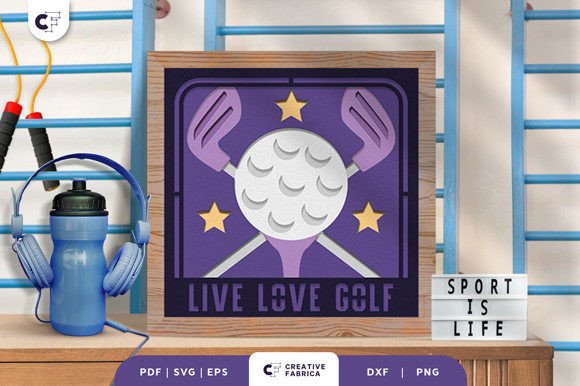
What makes this particular design so visually arresting is the interplay between negative space and dimensional depth. The design centers on two crossed golf clubs—often referred to as "sticks" in casual parlance—creating a strong "X" shape that anchors the composition. Behind this, the golf ball sits in the background, providing a spherical contrast to the linear shafts of the clubs. When you add the bottom text, "Live Love Golf," in a large, bold font, you create a balanced triangle of visual weight that draws the eye inward.
Unlike a flat print, a Golf Ball and Sticks 3D Layered Papercut creates shadows that change depending on the lighting in the room. This is achieved through the separation of layers—typically seven distinct layers in this specific design. Each layer adds roughly a few millimeters of depth, meaning the final piece pops out of the frame, creating a "window" effect. For a designer or crafter, this is an opportunity to play with color gradients. You might choose a monochromatic scheme—varying shades of green for a course feel—or high contrast black and white for a modern, graphic look. The versatility of the file formats (SVG, PDF, EPS, PNG, DXF) ensures that whether you are using a Cricut, Glowforge, or a CNC router, the vector integrity remains sharp, allowing for clean cuts on cardstock, plywood, or acrylic.
From Hobbyist Project to Commercial Product
While many will view this as a personal project to hang in a den or office, the commercial potential of a high-quality 3D shadow box should not be underestimated. If you run a small business selling handmade goods, or if you are an entrepreneur looking for unique corporate gifts, this design bridges the gap between "craft" and "premium product."
Consider the market for golf enthusiast gifts. It is a saturated market filled with generic mugs and polo shirts. A handmade, layered papercut shadow box offers a tactile, bespoke quality that mass-produced items cannot match. For branding purposes, a business related to golf courses, country clubs, or sports equipment could use this design as a high-end giveaway for VIP members or tournament winners. It serves as a sophisticated piece of packaging design or merchandise that reinforces a brand identity centered on tradition and quality.
Furthermore, the construction process itself is accessible. You do not need to be a master woodworker to assemble this. The requirement is simply precision and patience. By using adhesives like foam tape between the layers, you ensure the separation that creates the 3D effect. This accessibility means small business owners can produce these in small batches without investing in heavy industrial machinery, keeping overhead low while offering a high perceived value product.
Strategic Assembly and Material Selection
The success of the Golf Ball and Sticks 3D Layered Papercut relies heavily on the materials you select. While the files are optimized for standard cardstock, experimenting with different mediums can elevate the final result. For instance, using a heavy-weight textured cardstock can mimic the feel of a canvas, while cutting the design from stained plywood creates a rustic, cabin-style aesthetic perfect for a lodge or man cave.
When assembling the seven layers, think about the narrative of the piece. The background layer usually holds the golf ball. The middle layers construct the shafts and grips of the clubs. The top layers often feature the heads of the clubs and the bold typography. To ensure visual consistency and professional presentation, it is crucial to align the layers perfectly. Even a millimeter of misalignment can disrupt the symmetry of the crossed clubs.
Here is a practical checklist for assembly:
- Preparation: Ensure your cutting mat is clean and your blade is fresh to avoid tearing the paper fibers, especially around the golf ball's dimple pattern.
- Spacing: Use varying thicknesses of foam adhesive squares. You might use 2mm tape for the background layers and 3mm tape for the foreground to maximize depth perception.
- Framing: A shadow box frame with a glass front is essential to protect the delicate layers from dust and humidity while allowing the 3D effect to be viewed clearly.
Digital Applications and Marketing Assets
Beyond the physical construction, the digital files themselves are valuable design assets. For content creators, bloggers, and social media managers in the sports niche, the PNG and SVG files can be repurposed as high-quality graphics. Imagine a blog header featuring a 3D render of this design, or a social media post promoting a "Father's Day Gift Guide." The layered nature of the file allows you to animate the construction process in a video, creating engaging content that stops the scroll.
For those involved in logo design or brand identity, the crossed clubs motif is a classic symbol. However, by utilizing the layered aesthetic, you can modernize this classic symbol. It suggests that a brand is established and traditional, yet innovative and detail-oriented. This is particularly useful for startups in the golf tech space or boutique apparel brands that want to stand out from the standard serif-and-shield logos.
The "Live Love Golf" typography included in the design also serves as a study in font pairing. The large, blocky letters contrast with the thin lines of the club shafts. When creating your own marketing materials, take note of this balance. If you were to create accompanying flyers or invitations for a golf tournament, you would want to choose a premium font that complements this bold style—perhaps a clean sans serif font for the body copy to maintain readability, or a sophisticated serif font to evoke a sense of history and prestige.
Final Thoughts on the Crafting Experience
Creating a Golf Ball and Sticks 3D Layered Papercut is more than just following a set of instructions; it is an exercise in precision and an opportunity to create a meaningful object. Whether you are making it for a personal collection, a gift for a golf-loving client, or a product for your online store, the result is a piece that commands attention. It proves that with the right digital files and a bit of patience, you can turn flat materials into a dynamic tribute to the game of golf. The combination of the spherical ball, the angular sticks, and the solid text creates a composition that is timeless, versatile, and undeniably striking.